

AI Prompt Learning Center
Importance of AI Prompts in AI Systems

Did you know that the quality of a prompt can make or break an AI’s response? Crafting the right prompt is key to unlocking accurate, relevant outputs from AI systems. In this article, we’ll look closely into how AI prompts work and why refining them can improve decision-making, customer service, and content creation. Let’s explore how you can access the full potential of AI with well-structured prompts.
1. What Are AI Prompts?
AI prompts are the instructions, questions, or inputs you provide to an AI system to guide its response. Think of them as the way you “communicate” with the AI, giving it direction on what to do or what kind of information to provide.
Whether you ask the AI to generate a blog post, answer a question, or solve a problem, the prompt serves as the starting point for the AI to process and respond.
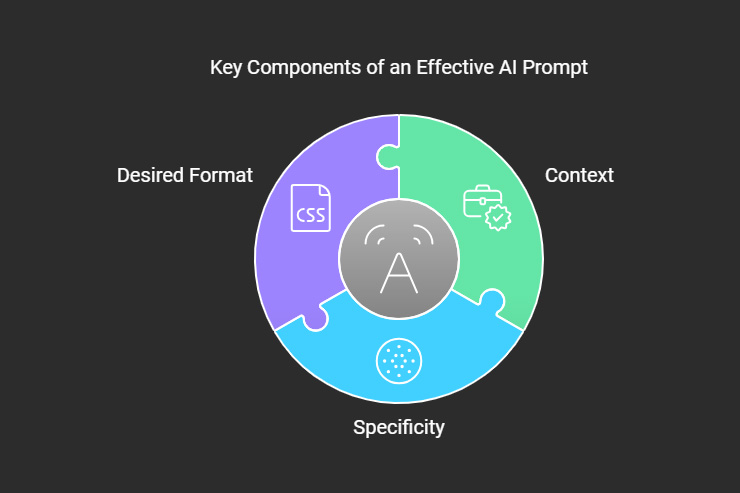
Why do AI Prompts Matter?
The quality and clarity of your prompts directly impact the AI’s performance. Well-crafted prompts help AI systems generate accurate, relevant, and contextually appropriate responses.
A vague or unclear prompt can result in an incomplete or off-target response, while a precise prompt can unlock the full potential of the AI’s capabilities. In essence, prompts guide the AI to produce the best possible output, making your interaction more productive.
Examples:
Here are a few simple examples that show how prompts influence AI’s response:
ChatGPT Prompt: “Write a 200-word article on the benefits of daily exercise.”
- Response: The AI generates a concise article outlining the physical and mental health benefits of regular exercise.
Google AI Search Prompt: “Best restaurants near me.”
- Response: The AI searches based on location and returns a list of popular nearby restaurants.
These examples illustrate that the prompt’s clarity determines the AI’s ability to provide relevant and helpful information.
The Technical Side of AI Prompts
AI prompts work by leveraging advanced NLP algorithms that break down user instructions into structured data inputs. This process, known as tokenization, enables the AI to understand the user’s intent by analyzing word patterns, syntax, and context.
Modern AI systems such as Generative Pre-trained Transformers (GPT) and BERT are trained on billions of parameters, which allow them to comprehend complex language models and generate accurate outputs.
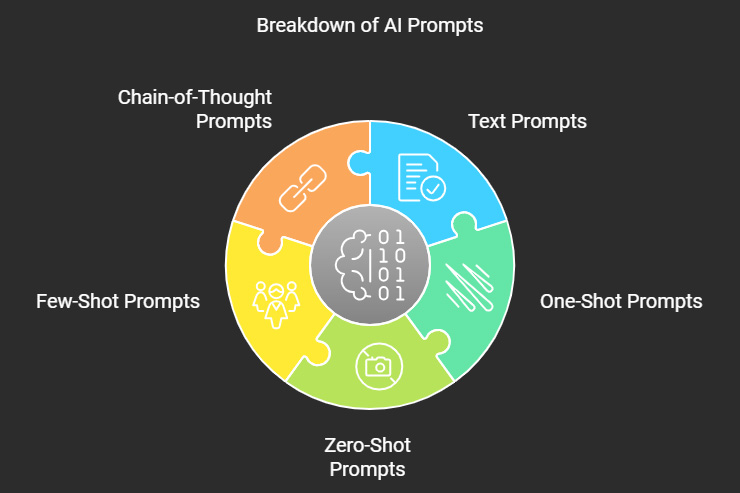
2. Types of AI Prompts
Text Prompts
These are the most commonly used prompts, especially for AI systems focused on text generation, like ChatGPT. Text prompts are typically written instructions or questions that guide the AI to generate a written response.
For example, “Explain how photosynthesis works” would prompt the AI to describe the process of photosynthesis in a clear, text-based format.
One-Shot Prompts
In a one-shot prompt, you provide the AI with a single example to help it understand the task. This is useful for specific situations where you want the AI to replicate a particular output based on just one example.
For instance, “Translate this sentence: ‘Hello, how are you?’ in French” gives the AI one example and expects a precise translation in return.
Zero-Shot Prompts
A zero-shot prompt asks the AI to complete a task without providing any examples. The AI relies solely on the prompt and its existing knowledge base.
For example, “Summarize the plot of the novel Moby Dick” is a zero-shot prompt since no prior examples are provided, and the AI must generate an answer based on the prompt alone.
- Real-World Application: In healthcare, a zero-shot prompt can be used to analyze unstructured patient data and generate medical insights without prior examples. For instance, AI could process patient symptoms and generate diagnostic recommendations based on historical medical data.
Few-Shot Prompts
In few-shot prompts, a handful of examples are provided to guide the AI’s response. This can improve the AI’s ability to generate accurate and contextually appropriate outputs. For example, you might ask the AI to write product descriptions and provide a few examples:
- Example 1: A lightweight, waterproof backpack for outdoor adventures.
Example 2: A sleek, portable charger that fits in your pocket. Now write a description for a travel-friendly laptop stand. - In customer service, few-shot prompts can train AI chatbots to handle complex customer queries. A few examples can be provided to guide the chatbot’s responses, helping it generate more accurate replies for varied customer service situations.
Chain-of-Thought Prompts
Chain-of-thought prompts are designed to encourage the AI to think step-by-step, allowing for more complex reasoning. This type of prompt is useful for solving problems or making decisions that require multiple stages of reasoning.
For example, “Explain the steps involved in balancing a chemical equation” would lead the AI to outline the process step-by-step, rather than providing a simple summary.
- Real-World Application: In finance, chain-of-thought prompts can help AI systems perform multi-step tasks such as investment analysis or risk assessment. By prompting the AI to break down investment strategies into logical steps, finance teams can make more informed decisions.
Examples of Prompt Types in Action
- Text Prompt: “Generate a poem about the ocean.”
- One-Shot Prompt: “Translate: ‘Good morning’ into Spanish.”
- Zero-Shot Prompt: “Describe the features of a smartphone.”
- Few-Shot Prompt: “Here are two taglines for a coffee brand: 1) ‘Brewed to Perfection,’ 2) ‘Your Morning Boost.’ Now, create a third tagline.”
- Chain-of-Thought Prompt: “Explain the steps needed to plan a wedding, starting with budgeting and ending with the reception.”
Each type of prompt serves a different function, guiding the AI to produce varied and tailored responses based on how much information or guidance is provided.
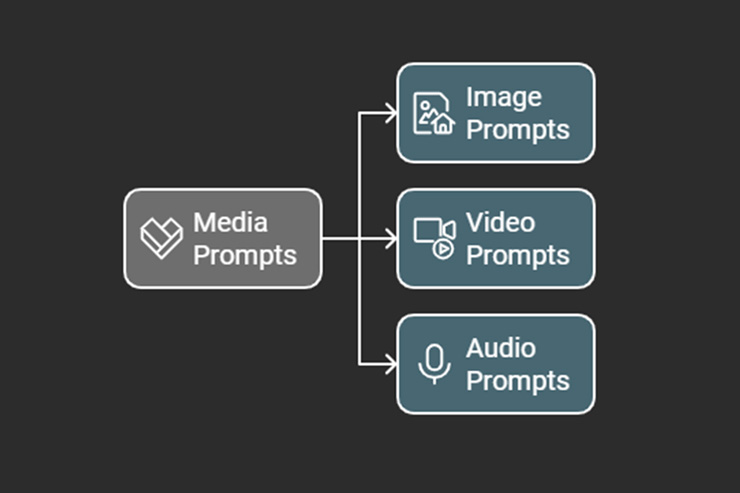
3. Image, Video, and Audio Prompts
Image Prompts
In AI tools like DALL·E and MidJourney, image prompts guide the AI to generate visual content from an image or text description. For example, providing a landscape image or a prompt like “A futuristic city at sunset” allows the AI to create a corresponding visual representation. Image prompts enable creativity and personalization in fields such as graphic design and marketing..
Video Prompts
AI systems like RunwayML and Synthesia use video prompts to generate or edit videos based on user input. For example, uploading a video clip can prompt the AI to alter backgrounds, add animations, or generate captions and insights. This is useful in video editing, content creation, and educational videos where AI enhances learning experiences..
Audio Prompts
AI can also be prompted with sound or voice inputs. Tools like OpenAI’s Whisper use audio prompts to transcribe speech or generate audio outputs like music or voiceovers. For instance, providing an audio recording of a meeting can prompt the AI to transcribe or summarize key points. Audio prompts are also used in creative fields for generating soundtracks or voice modulation.
Examples of AI Tools Using Non-Text Prompts
- DALL·E: Generate images from text or image inputs.
- RunwayML: Video editing and creation based on video inputs.
- Whisper: Audio transcription and analysis from sound inputs.
These non-text prompts broaden the scope of how AI can be used in creative, analytical, and professional applications.
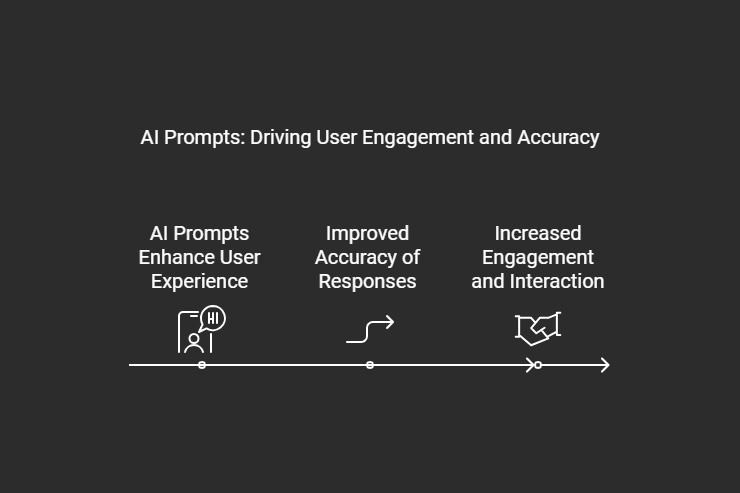
4. Role of AI Prompts in AI Systems
Enhancing User Experience
AI prompts improve user experience by enabling smooth, intuitive interactions. Clear prompts, like “Summarize a 10-page report in 3 bullet points,” guide AI to respond quickly and accurately, reducing frustration and ensuring the response meets expectations..
Accuracy of Responses
Prompts directly impact how accurate an AI’s response will be. A vague prompt can lead to off-target or incomplete answers, while a precise, detailed prompt allows the AI to generate more accurate, meaningful information.
For example, compare the responses to these two prompts:
- Vague prompt: “Explain history.”
- AI response: A broad, general explanation of world history.
- Specific prompt: “Explain the causes and effects of the American Civil War.”
- AI response: A focused and detailed answer tailored to a specific historical event.
Engagement and Interaction
Prompts also drive more engaging and interactive experiences with AI systems. Whether you’re using AI in a chatbot, a virtual assistant, or a creative tool, the more engaging the prompt, the more dynamic the interaction.
For example, asking an AI to “create a fictional world with unique cultures and languages” leads to a more creative and immersive experience than a basic prompt like “describe a city.” This enhances engagement, allowing users to interact with AI in more creative and satisfying ways.
Examples of AI Responses Based on Different Prompts:
- Simple Prompt: “Tell me about space.”
- AI Response: General facts about space exploration and astronomy.
- Specific Prompt: “What are the key milestones in NASA’s Mars exploration missions?”
- AI Response: A detailed list of milestones specific to Mars exploration.
This comparison highlights how prompt specificity directly influences the level of detail and relevance in the AI’s response.
Technical Insight
AI models like GPT-4 use transformer architectures with self-attention mechanisms to assess how words in a prompt relate to each other. This enables the model to generate contextual responses, even for complex queries.
Refining prompts helps businesses extract more accurate insights, improving decision-making in industries like healthcare (diagnostics) and retail (personalized recommendations).
5. Why Are Prompts Important in AI Systems?
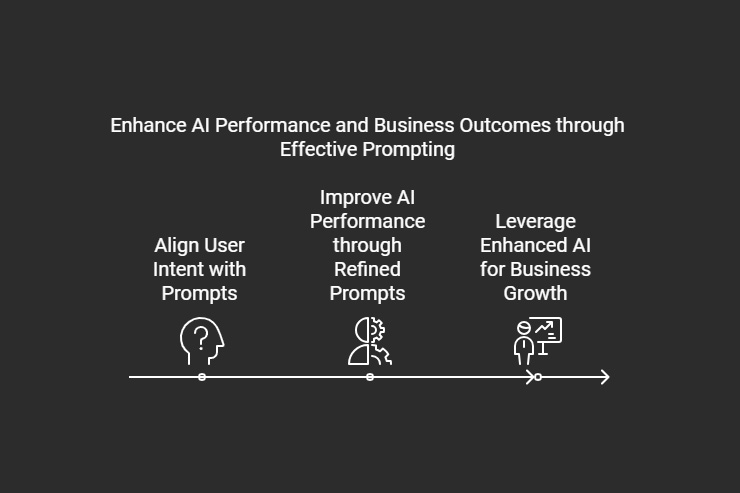
Important for User Intent Alignment
AI prompts ensure alignment with user intent, helping the system interpret commands accurately. Clear prompts like “Summarize Moby Dick” provide direction, but adding specifics, like “Summarize Moby Dick in 3 sentences focusing on main plot points,” improves precision. Well-structured prompts are key for accurate results.
Important for Improving AI Performance
Optimized prompts enhance AI performance by providing clarity and context. For instance, “Write an article about marketing” is vague, but refining it to “Write a 300-word article on digital marketing strategies for small businesses in 2024” ensures a more accurate, relevant response. Clearer prompts lead to better outcomes.
Improving AI Performance in Business
In e-commerce, well-structured prompts can significantly enhance product recommendation algorithms. For example, a refined prompt like, “Generate personalized product suggestions based on a user’s purchase history and browsing behavior,” allows AI to offer more targeted product recommendations, improving customer satisfaction and conversion rates.
Examples: Poor vs. Optimized Prompts
- Poor Prompt: “Tell me about climate change.”
- AI Response: A broad, generalized explanation of climate change, lacking focus on any specific area.
- Optimized Prompt: “Explain the key causes of climate change in industrialized countries and their impact on global temperatures.”
- AI Response: A focused, detailed explanation tailored to industrialized countries and the effects on global temperatures, directly addressing the prompt.
The optimized prompt leads to a more relevant and informative response, highlighting how specific prompts improve AI performance.
Case Study: ChatGPT and Enhanced Outcomes
Let’s take an example from ChatGPT to illustrate how well-crafted prompts can lead to improved outcomes. A company using ChatGPT for customer support initially used vague prompts such as, “Help the customer with their issue.” The AI responses were too generic, often failing to address specific customer concerns.
After refining the prompt to something more specific, like “Analyze the customer’s message and provide a clear solution for a billing issue while maintaining a friendly tone,” the company saw a significant improvement in customer satisfaction.
The more detailed prompt provided the AI with clear instructions on how to interact, leading to a better alignment with user needs and a more appropriate response.
6. Applications of AI Prompts
User Experience and Engagement
Clear AI prompts improve interactions with systems like chatbots and virtual assistants, ensuring precise and meaningful responses. For example, a prompt like “Set a reminder for my meeting with John tomorrow at 10 AM” creates smooth, satisfying user experiences by delivering accurate outcomes..
Accuracy and Performance
Specific AI prompts enhance accuracy. A prompt like “Identify the symptoms of influenza in children under 10” generates a focused response, while a vague one like “Tell me about influenza” may not. Well-structured prompts lead to more efficient, relevant results.
Customization and Personalization
Tailored AI prompts create personalized solutions. For example, a fitness app using “Create a custom workout plan for someone with 30 minutes a day to exercise” delivers a workout aligned with user needs, enhancing personalization.
Enhanced Customer Service
AI-driven chatbots rely on prompts to deliver faster and more accurate customer support. Prompts like “Explain the steps to reset my password” allow chatbots to provide immediate assistance, helping users resolve their issues without waiting for a human representative. This streamlines the customer service process and ensures that users get the help they need quickly and effectively.
Educational Tools
In educational applications, AI prompts help systems provide detailed explanations, answer questions, and facilitate learning. For example, an AI-based learning system like Quizlet can respond to prompts like “Explain the causes of the American Revolution” by delivering a clear and concise summary, aiding students in understanding complex concepts more easily.
Content Generation
AI tools such as Jasper and ChatGPT can use prompts to generate blog posts, articles, or even creative content like poems or images. A simple prompt like “Write a 500-word article on digital marketing trends in 2024” allows the AI to generate content that can be refined and personalized based on user needs, saving time and effort in content creation.
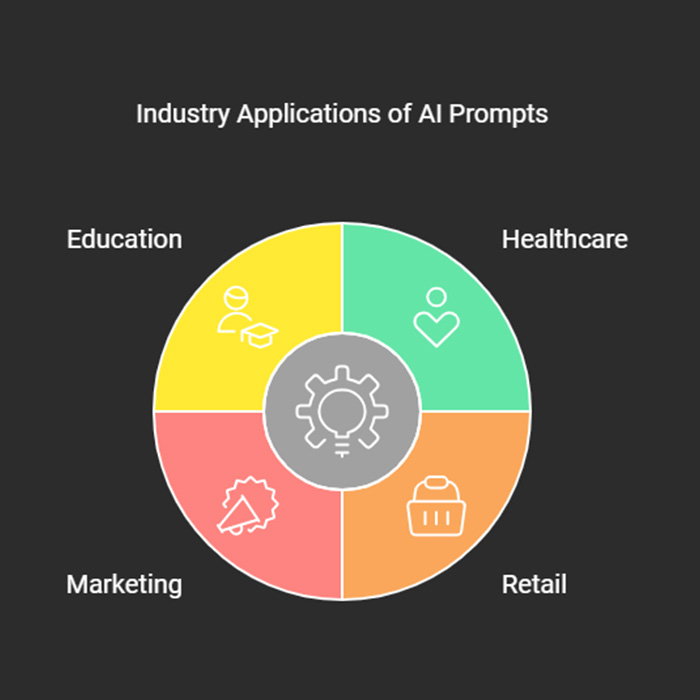
Examples of AI Prompt Applications in Various Industries:
- Healthcare: In healthcare, AI prompts help process complex medical data to generate personalized treatment plans. For example, an AI-driven diagnostic system might use a prompt like, “Summarize patient’s symptoms and recommend next steps for treatment,” allowing healthcare providers to offer faster, more accurate care.
- E-commerce: AI-powered recommendation engines rely on refined prompts to deliver personalized shopping experiences. By analyzing user behavior, prompts like, “Suggest relevant products based on past purchases and current trends,” enable e-commerce platforms to increase engagement and boost sales.
- Customer Service: AI chatbots improve response accuracy through optimized prompts. For instance, a prompt like, “Provide a solution to a billing issue for a premium account user,” ensures AI systems offer precise, contextual answers, improving customer satisfaction.
- Retail: In retail, AI prompts streamline inventory management and pricing strategies. For example, a prompt like, “Analyze sales data and recommend pricing adjustments for slow-moving products,” can help retailers optimize stock and pricing for maximum profitability.
- Marketing: AI-driven marketing platforms use prompts to create targeted ad campaigns and content. For instance, a prompt such as, “Generate a social media campaign targeting young professionals interested in sustainable fashion,” allows businesses to deliver personalized, data-driven content that resonates with their audience.
- Education: In education, AI systems use prompts to assist with personalized learning plans. For example, a prompt like, “Create a study guide on the American Revolution for 8th graders,” helps educators offer tailored content that matches the learning level of their students.
7. How to Write Effective AI Prompts
Understanding AI Capabilities:
To write effective AI prompts, it’s important to understand the strengths and limitations of the AI system you’re using. AI can process large amounts of data and generate creative content, but it may struggle with vague or overly complex instructions. Knowing the capabilities of AI will help you maximize its potential, while also setting realistic expectations for its responses.
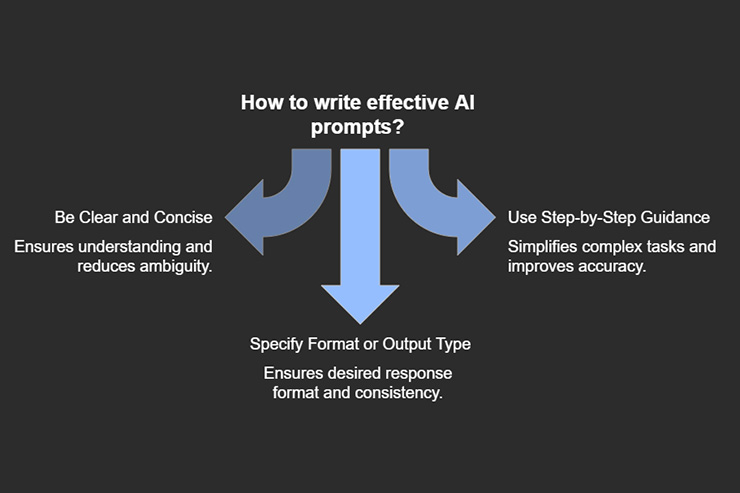
Best Practices to write AI Prompts:
- Be Clear and Concise:
The more precise your prompt, the more relevant and accurate the AI’s response will be. Avoid vague instructions. For example, instead of saying, “Tell me about marketing,” you can say, “Provide a list of digital marketing strategies for small businesses.” - Use Step-by-Step Guidance for Complex Tasks:
Break down complex requests into smaller, manageable steps. This helps the AI follow your instructions more clearly. For example, instead of asking, “Create a business plan,” you can guide the AI with a more detailed prompt like, “Create a step-by-step business plan for a startup focused on eco-friendly products.” - Specify Format or Output Type:
You can enhance the AI’s response by specifying the format in which you want the information. For instance, you might ask, “Summarize the main points of this article in bullet points” or “Create a numbered list of steps for setting up a website.”
Examples:
Basic Prompt: “Create a marketing strategy.”
- AI Response: General and broad overview of a marketing strategy.
Effective Prompt: “Create a step-by-step marketing strategy for a small business focusing on social media.”
- AI Response: A detailed, structured strategy tailored to social media marketing for small businesses, broken down into specific steps.
By using these best practices and understanding the AI’s capabilities, you can write effective prompts that maximize the potential of AI systems, ensuring they provide accurate, relevant, and useful responses.
8. Challenges and Limitations of AI Prompts
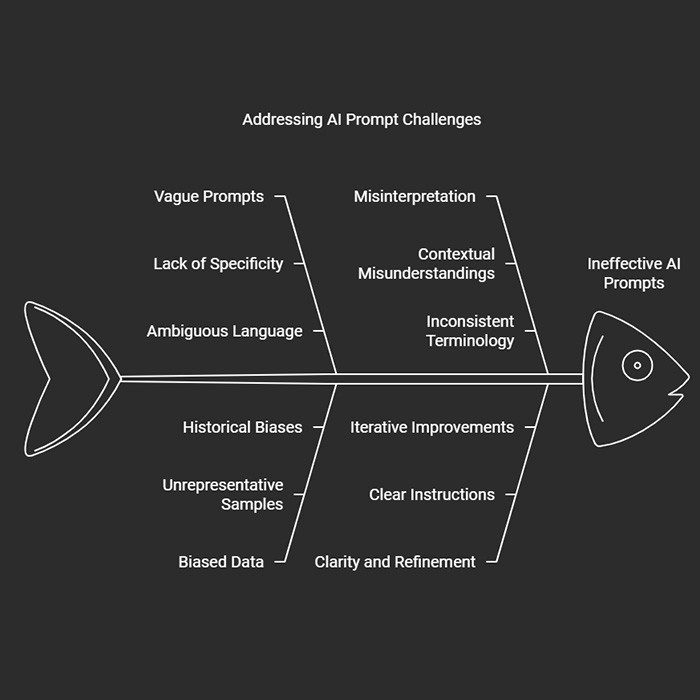
- Over-reliance on Input Quality: The quality of a prompt directly affects AI output. Vague prompts like “Tell me about technology” lead to unfocused responses, while clear prompts like “Explain key AI trends in 2024” yield more precise answers. Users must refine their prompts to improve AI performance—the better the input, the better the output.
- AI’s Limitations in Interpretation: Despite advancements, AI still struggles with ambiguous language, cultural references, and full context. Biases in training data can skew results, as AI relies on patterns rather than subjective understanding. For example, asking “What is the best movie ever made?” might produce biased answers based on the data it has learn.
- Bias in AI Systems: One of the major challenges is ensuring that prompts do not inadvertently introduce biases into the AI’s response. For example, AI models trained on biased datasets may provide skewed responses to prompts, especially in sensitive sectors like law enforcement or financial services. Ongoing work in fairness and bias mitigation is crucial in prompt engineering to ensure ethical AI outputs.
- Model Overfitting: In industries like cybersecurity, there’s a risk of overfitting, where an AI model becomes too tailored to specific prompts, resulting in less generalized performance across new datasets. Continuous prompt refinement is essential to avoid this pitfall.
Studies have shown that the quality of AI responses improves significantly with better prompts. For instance, according to OpenAI research, refining prompts can improve the accuracy of AI responses by up to 30%. In contrast, poorly structured prompts may lead to irrelevant or incomplete answers, reducing the AI’s effectiveness.

9. Future of AI Prompts
- Expansion of AI Applications: As AI systems evolve, the role of prompts will become even more significant. Future AI applications will likely handle increasingly complex tasks, from generating entire business strategies to crafting personalized healthcare recommendations. This evolution will require more sophisticated prompts capable of guiding AI through multifaceted tasks, pushing the boundaries of what AI can accomplish.
- Higher User Engagement: AI prompts will also drive more interactive and personalized user experiences. As users become more comfortable with refining and experimenting with prompts, AI will be able to deliver responses that feel more tailored to individual needs. For example, AI could offer real-time advice based on prompts that continuously adapt to user behavior and preferences.
- Advancements in Prompt Engineering Techniques: The field of prompt engineering—the process of designing and refining prompts to improve AI outputs—is rapidly growing. Engineers and developers are exploring ways to make prompts smarter, helping AI interpret and generate more complex and nuanced responses. These advancements will have a significant impact on AI systems’ accuracy and utility in various industries, from marketing to healthcare.
- Automated prompt generation: Friven by advancements in AutoML (Automated Machine Learning), will likely play a larger role. AI systems might soon generate and refine their own prompts based on real-time user feedback, minimizing human intervention and improving efficiency, especially in large-scale industries like manufacturing and supply chain management
Sam Altman, CEO of OpenAI, has said, “The future of AI lies in its ability to understand and generate content based on user intent, and prompt engineering will be a key factor in unlocking that potential.” This quote highlights the importance of improving how we interact with AI to maximize its future capabilities.
10. Practical Takeaways: How You Can Leverage AI Prompts
Step-by-Step Guide:
- Identify the Purpose of Your Prompt:
Before writing your prompt, understand what you want to achieve. Are you looking for information, creative content, or a specific output? Defining your purpose will help you structure a more effective prompt. - Be Clear and Specific in Your Input:
Avoid vague or broad prompts. Instead, be specific about the type of response you want. For example, instead of “Tell me about social media,” you could ask, “What are the best social media marketing strategies for small businesses in 2025?” - Refine and Iterate Your Prompts for Better Results:
If the AI’s first response isn’t exactly what you expected, don’t hesitate to refine your prompt. Make adjustments by adding more context or detail. This iterative process helps you get more accurate and relevant answers.
Resources:
What Is Prompt Engineering in Design? (Source)
Prompt Design and Engineering: Introduction and Advanced Methods (Source)
What is Prompt Engineering in AI and How Does it Work? (Source)
Further readings:
The Rise of AI Ethics
Will Artificial Intelligence Make or Break Small Businesses?
