

AI Prompt Learning Center
Chain-of-Thought Prompting a Easy Step-by-Step Guide

What if you could solve complex problems with the precision of a machine and the creativity of a human mind? Chain-of-Thought (CoT) prompting makes this possible by breaking down challenges into manageable steps.
In this article, you’ll learn how to use CoT prompting to improve decision-making, sharpen analytical skills, and tackle problems in any domain.
1. What is Chain-of-Thought Prompting?
Chain-of-Thought (CoT) prompting is a step-by-step problem-solving method used by both humans and AI. Like a detective solving a mystery, it breaks down complex issues into manageable parts, guiding you from one step to the next. Similar to planning a road trip, CoT prompting helps map out each phase to reach a solution.

Championed by organizations like OpenAI and Google Research, CoT enhances reasoning and logical thinking. Whether you’re in business, tech, or just want to improve your problem-solving, CoT offers a structured way to tackle complexity and discover innovative solutions.
Did you now, The concept of chain-of-thought prompting was introduced in 2022 in a seminal paper by the Google Brain team presented at the NeurIPS conference in 2022. This research demonstrated that CoT prompting outperformed traditional prompting methods across various reasoning benchmarks, including arithmetic and common-sense reasoning tasks.
2. The Power of Sequential Reasoning
Chain-of-Thought prompting harnesses the power of sequential reasoning to dramatically improve decision-making and complex problem-solving. By encouraging step-by-step thinking, CoT helps you navigate through intricate challenges with greater clarity and precision.

Imagine you’re facing a complex business decision, such as whether to launch a new product line. Instead of relying on gut instinct or becoming overwhelmed by the multitude of factors involved, CoT prompting guides you through a logical sequence of considerations:
- Market analysis: What’s the current demand for this type of product?
- Competition assessment: Who are our competitors and how does our offering differ?
- Production capabilities: Can we manufacture the product efficiently?
- Financial projections: What are the costs and potential returns?
- Marketing strategy: How will we promote and distribute the product?
This step-by-step approach resembles a decision tree, where each choice leads to new branches of consideration. By breaking down the problem into these manageable steps, you can make more informed decisions and identify potential issues before they become roadblocks.
CoT’s sequential reasoning isn’t just about listing steps—it’s about building a logical chain where each link connects to the next. This interconnected thinking helps you spot relationships between different aspects of a problem that might not be immediately obvious, leading to more comprehensive and innovative solutions.
Check out this detailed guide on Few-Shot Prompting to learn how to go about this.
Did you now, that Chain-of-thought prompting in job interviews assesses candidates’ critical thinking, logical reasoning, and communication skills, offering insights into their problem-solving approach and role fit.
3. Practical Applications of Chain-of-Thought Prompting
The beauty of Chain-of-Thought prompting lies in its versatility. Let’s explore how this technique can be applied across various domains:

AI and Coding
In the world of artificial intelligence and software development, CoT prompting is revolutionizing how we approach complex algorithms. For instance, when designing a machine learning model for image recognition:
- Data collection: What types of images do we need?
- Preprocessing: How should we clean and prepare the data?
- Model selection: Which architecture is best suited for our task?
- Training process: How can we optimize the learning process?
- Evaluation: What metrics should we use to assess performance?
- Iteration: Based on results, what adjustments are needed?
By following this chain of thought, developers can create more robust and efficient AI systems, anticipating challenges at each stage of the process.
Business Strategy
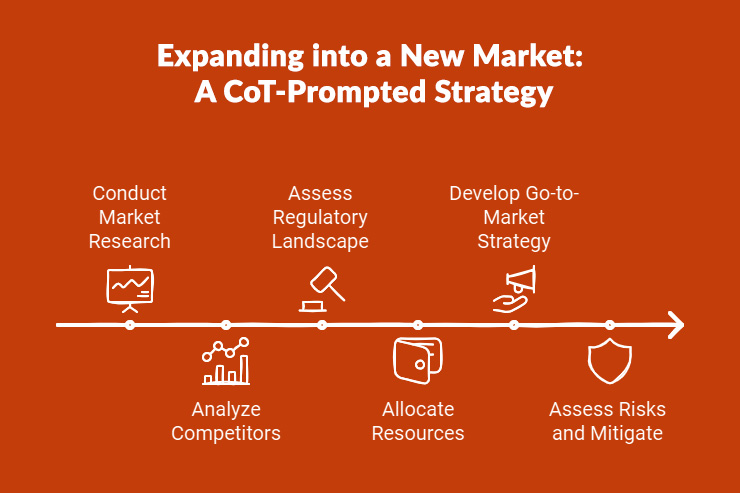
In the corporate world, CoT prompting can give you an advantage for strategic planning. Let’s apply it to the challenge of expanding into a new market:
- Market research: What are the demographics and consumer behaviors in the target market?
- Competitive analysis: Who are the key players, and what are their strengths and weaknesses?
- Regulatory landscape: What legal considerations do we need to address?
- Resource allocation: What human and financial resources are required?
- Go-to-market strategy: How will we position and introduce our product or service?
- Risk assessment: What potential obstacles might we face, and how can we mitigate them?
This structured approach ensures that no critical aspect of the expansion is overlooked, leading to more comprehensive and successful strategies.

Everyday Problem Solving
CoT prompting isn’t just for big business decisions or complex coding challenges—it’s equally valuable in everyday life. Consider the task of planning a large family reunion:
- Guest list: Who should be invited, and how many people are we expecting?
- Venue selection: Based on the guest list, what locations can accommodate our group?
- Date and time: When is the best time to ensure maximum attendance?
- Budget: What are our costs, and how will we manage expenses?
- Activities: What entertainment or events should we plan?
- Logistics: How will we handle travel arrangements, accommodations, and food?
By breaking down this potentially overwhelming task into manageable steps, you can ensure a well-organized and enjoyable event for everyone involved.
4. Actionable Chain-of-Thought Techniques
Now that we understand the power and applications of Chain-of-Thought prompting, let’s explore some actionable techniques you can start using today to enhance your problem-solving skills.
Break Problems into Steps
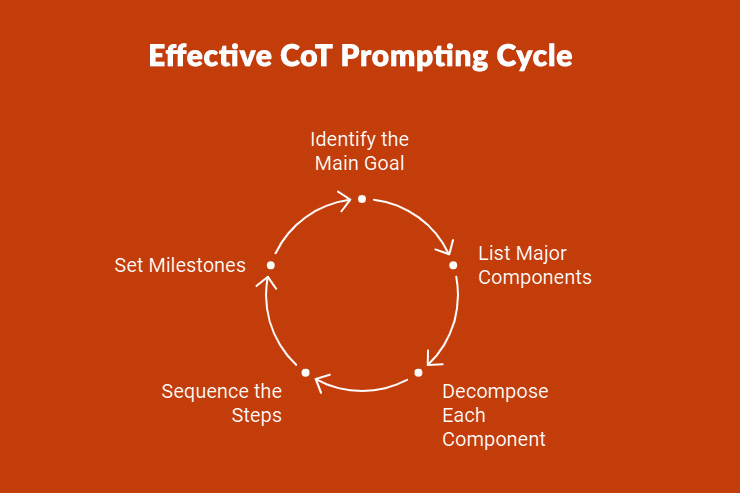
The cornerstone of effective CoT prompting is the ability to break large, complex problems into smaller, manageable steps. Here’s how you can master this technique:
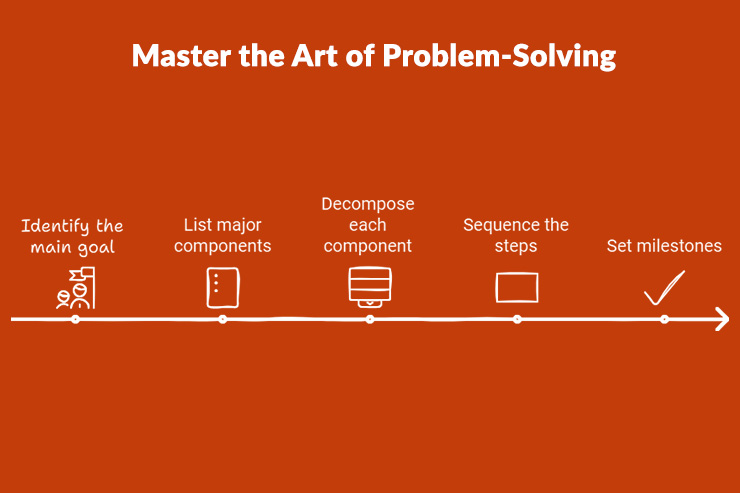
- Identify the main goal: Clearly define what you’re trying to achieve.
- List major components: Outline the primary elements or stages of the problem.
- Decompose each component: Break down each major element into smaller, actionable tasks.
- Sequence the steps: Arrange the tasks in a logical order.
- Set milestones: Create checkpoints to track progress and reassess as needed.
For example, if your goal is to launch a new website, your steps might look like this:
- Plan content structure
- Design user interface
- Develop backend functionality
- Create and integrate content
- Test and debug
- Launch and monitor
Break down the process to transform a daunting project into a series of achievable tasks.
Ask Questions Along the Way
Incorporating “what if” questions at each step of your chain of thought can uncover hidden problems and lead to innovative solutions. This technique helps you anticipate challenges and think creatively. For instance:
- What if our assumptions are wrong?
- What if we encounter unexpected obstacles?
- What if we approach this from a different angle?
Let’s apply this to our website launch example:
- What if our target audience prefers mobile devices? (This might influence design decisions)
- What if we experience a traffic spike on launch day? (This could impact server requirements)
- What if our content strategy doesn’t resonate with users? (This might necessitate a flexible content management system)
Ask these questions, to address potential issues and refine your approach.
Use CoT for Group Collaboration
Chain-of-Thought prompting can significantly enhance team problem-solving. Here’s how to leverage CoT techniques in a group setting:
- Define the problem collectively: Ensure everyone has a clear understanding of the challenge.
- Individual brainstorming: Have team members use CoT prompting to generate their own step-by-step solutions.
- Share and combine ideas: Present individual chains of thought to the group.
- Collaborative refinement: As a team, discuss and refine the steps, incorporating the best ideas from each chain.
- Assign responsibilities: Delegate specific steps or sub-tasks to team members based on their expertise.
- Regular check-ins: Use the CoT framework to track progress and make adjustments as needed.
Diverse perspectives are leading to more comprehensive and innovative solutions. Learn Zero-Shot Prompts are beneficial for prompting.
5. Common Pitfalls and How to Avoid Them
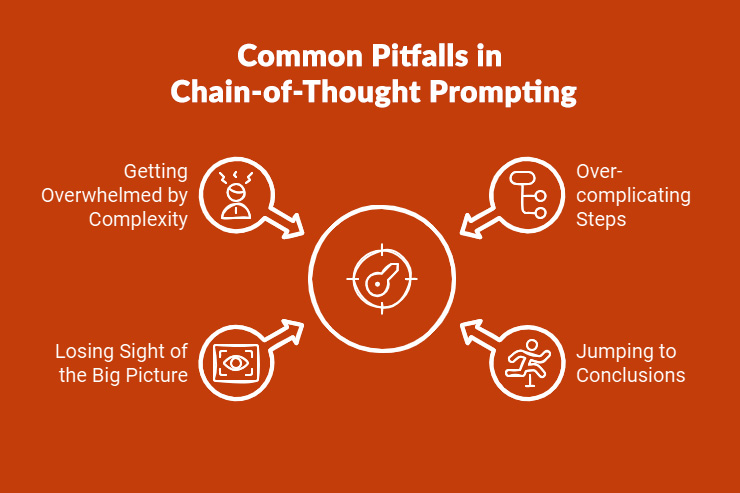
While Chain-of-Thought prompting is a powerful technique, there are some common pitfalls to be aware of:
Over-complicating the Steps
It’s easy to fall into the trap of creating too many steps or making them overly detailed. This can lead to analysis paralysis and hinder progress.
How to avoid it:
- Start with broad steps and only break them down further if necessary.
- Focus on key decision points and major actions.
- Regularly step back and ask, “Is this level of detail necessary to solve the problem?”
Jumping to Conclusions
Sometimes, the desire for a quick solution can lead to skipping steps or making assumptions without proper consideration.
How to avoid it:
- Resist the urge to rush. Trust the process and give each step due consideration.
- Explicitly state and challenge your assumptions at each step.
- Use the “what if” technique to explore alternative possibilities before settling on a conclusion.
Losing Sight of the Big Picture
When focusing on individual steps, it’s possible to lose track of the overall goal or miss important connections between different parts of the problem.
How to avoid it:
- Regularly revisit your main objective and ensure each step aligns with it.
- Create a visual representation of your chain of thought (e.g., a flowchart or mind map) to see how all the steps connect.
- After completing your chain, take a step back and ask, “Does this solution fully address the original problem?”
Getting Overwhelmed by Complexity
Some problems are inherently complex, and breaking them down can sometimes reveal even more complexity, leading to feelings of being overwhelmed.
How to avoid it:
- Remember that it’s okay to start with a simplified version of the problem and add complexity gradually.
- Focus on one step at a time rather than trying to solve everything at once.
- Don’t hesitate to iterate. Your first chain of thought doesn’t have to be perfect.
- Take breaks to maintain a fresh perspective.
By being aware of these potential pitfalls, you can maximize the effectiveness of your Chain-of-Thought prompting and tackle complex problems.

6. Advanced Chain-of-Thought Prompts
To help you master Chain-of-Thought prompting, here are some advanced prompts you can use to practice and apply in various scenarios:
General Problem-Solving Prompts
- “What’s the first small problem I need to solve in this larger issue?”
- “If I solve this step, what new challenges might arise?”
- “How does this step connect to the overall goal?”
- “What assumptions am I making at this stage, and how can I validate them?”
- “What’s the potential impact if this step fails, and how can I mitigate that risk?”
Industry-Specific CoT Prompts
Technology
- “How can we break down the process of implementing a new feature in our software?”
- “What are the steps to diagnose and resolve a complex system outage?”
Healthcare
- “How can we improve patient flow in the emergency department?”
- “What’s the process for developing and implementing a new treatment protocol?”
Education
- “How can we design a curriculum that adapts to individual student needs?”
- “What steps are needed to implement a successful distance learning program?”
Business
- “How can we enter a new market while minimizing risks?”
- “What’s the process for optimizing our supply chain efficiency?”
Environmental Science
- “How can we develop a comprehensive plan to reduce urban air pollution?”
- “What steps are involved in implementing a community-wide recycling program?”
By regularly practicing with these AI prompts, you’ll develop a habit of structured thinking that can be applied to any complex problem you encounter.
Conclusion
Chain-of-Thought (CoT) prompting is a practical method for breaking down complex problems step by step. By encouraging clear, structured thinking and asking the right questions, CoT helps you approach difficult tasks with confidence. In this article, we’ve explored how CoT works in fields like AI and everyday problem-solving, offering techniques you can apply immediately.
FAQ
How can I use Chain-of-Thought (CoT) prompting for personal decision-making?
CoT prompting helps break decisions into smaller steps. Start by asking key questions like “What are my main options?” and “What are the pros and cons of each choice?” This method helps you think things through and avoid rushed decisions.
What tools can support Chain-of-Thought prompting?
Mind-mapping tools like MindMeister or XMind can help you visualize and organize your thoughts. You can also use AI tools like ChatGPT to guide your CoT process and brainstorm ideas more effectively.
How can CoT prompting help manage multiple tasks or projects?
Break each project into smaller tasks and prioritize them. For example, ask, “Which task is most important?” or “What needs to be done first?” This keeps you focused and makes managing several projects easier.
Can Chain-of-Thought prompting improve learning and retention?
Yes. When learning something new, break the topic into smaller parts. Ask questions like, “What’s the main idea?” and “How do the details fit together?” This method helps you understand the material better and retain it longer.
How does Chain-of-Thought prompting boost creativity?
CoT prompting encourages you to explore ideas step by step. For example, when brainstorming, ask questions like, “What problem does this solve?” and “What unique features could it have?” This leads to more creative and organized thinking.
What are common mistakes when using Chain-of-Thought prompting?
Some people overcomplicate the process by breaking problems into too many steps, which slows them down. Others skip steps and miss key insights. The goal is to keep it simple but thorough.
Can Chain-of-Thought prompting improve time management?
Yes. By breaking tasks into steps and prioritizing them, you can manage your time more effectively. Ask questions like, “What’s urgent?” and “What can be delegated?” This method helps you focus on what matters most.
Business that Benefits from Chain-of-Thought Prompts
Investment: Chain-of-thought prompts help investors break down complex financial decisions into clear steps, improving risk assessment and strategy formulation. This structured approach ensures more thorough evaluations of market trends and potential returns.
Business Managers: Chain-of-thought prompts guide managers through detailed decision-making processes, allowing them to tackle challenges systematically. This leads to more informed strategies and efficient problem-solving across the organization.
Product Managers: Chain-of-thought prompting allows product managers to deconstruct product development stages, ensuring no critical steps are overlooked. It enhances planning, feature prioritization, and cross-functional collaboration.
PR Managers: For PR managers, chain-of-thought prompts help map out communication strategies step-by-step, ensuring that messaging is clear and well-planned. This approach improves response to crises and consistency in brand storytelling.
Narrative Writers: Chain-of-thought prompts aid narrative writers by helping them structure their storylines and plot points sequentially. This technique keeps the narrative cohesive while allowing creativity to flourish within a logical framework.
Enhance your prompting skills and explore more guides at our AI Prompt Learning Center to stay ahead in AI.
References:
Wei, J., Wang, X., Schuurmans, D., Bosma, M., Ichter, B., Xia, F., Chi, E., Le, Q., & Zhou, D. (2022). Chain-of-Thought Prompting Elicits Reasoning in Large Language Models. arXiv preprint arXiv:2201.11903. https://arxiv.org/abs/2201.11903
OpenAI. (2022). How Chain-of-Thought Reasoning Improves AI Decision-Making. OpenAI Blog: https://openai.com/blog/chain-of-thought-prompting
Learn more about AI Prompt Techniques and Engineering
» Few-Shot Prompting
» Zero-Shot Prompting
» Crafting Effective AI Prompts
» AI Prompt Techniques and Strategies
» AI Prompt Optimization Methods
» AI Prompt Templates
