

AI Prompt Learning Center
Crafting Effective AI Prompts: Techniques for Better Results

•Did you know that a well-crafted prompt can improve AI-generated results by up to 80%? Whether you’re using AI for content creation, problem-solving, or data analysis, the quality of your prompt directly influences the output. Crafting effective AI prompts is not just about asking questions—it’s about communicating clearly and specifically with the AI to unlock its full potential.
1. Why Crafting Effective AI Prompts is Key to AI Success
Mastering prompt creation makes AI tools like ChatGPT and Google Gemini far more effective. It leads to faster, more accurate responses, reduces the need for clarification, and minimizes frustration.
Crafting precise, structured prompts maximizes productivity and ensures tailored results. A well-crafted prompt guides the AI to deliver relevant, focused outputs, making it a reliable tool for tasks like generating strategies, summarizing information, or analyzing data.
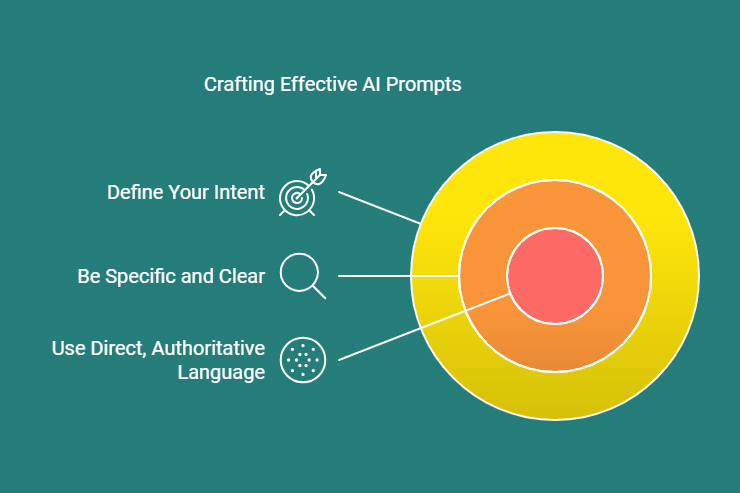
2. Core Principles of Crafting Effective AI Prompts
Why Is It Important to Define Your Intent Before Writing a Prompt?
Defining your intent is essential for crafting effective prompts. Clear goals lead to more targeted, valuable AI responses. Without a clear objective, you risk vague or irrelevant results.
For instance, there’s a major difference between asking for general information and seeking specific advice. Compare these two prompts:
- General Information: “What is digital marketing?” yields a broad overview.
- Specific Advice: “What are the top 3 strategies for digital marketing for a small e-commerce business?” generates actionable, tailored advice.
By setting clear goals, the AI’s response will better align with your needs.
How Does Being Specific and Clear Lead to Better AI Responses?
Specificity is key in AI prompts. Vague prompts lead to incomplete or irrelevant answers, as the AI lacks the necessary context. The clearer and more detailed your prompt, the more useful the response.
Here’s an example of how vague prompts can lead to unhelpful answers:
- Bad Prompt: “Tell me about AI.” This can result in a broad, unfocused answer.
Good Prompt: “Summarize the latest advancements in AI for content creation.” This targets a specific area, ensuring a relevant response.
Including context helps the AI understand and focus on what you’re asking. Always aim for clarity and precision to avoid irrelevant or broad outputs.
Why Should You Use Direct, Authoritative Language When Writing AI Prompts?
When interacting with AI, it’s best to use direct and authoritative language. While politeness is valued in human communication, it can dilute the clarity of your request in AI interactions.
Adding phrases like “Could you please” or “If possible” introduces ambiguity, making it harder for the AI to discern your intent.
Consider this example:
- Polite Prompt: “Could you please explain machine learning if it’s not too much trouble?”
The AI might process unnecessary words like “please” and “if it’s not too much trouble” and produce a less focused response. - Authoritative Prompt: “Explain the basic principles of machine learning.”
Here, the AI is given a clear command and can focus solely on delivering the requested information without unnecessary polite modifiers.
3. Structuring Your Prompts for Maximum Clarity
How to Define the Desired Output Format in AI Prompts?
The structure of your prompt affects the clarity and usefulness of the AI’s response. By specifying the output format, like lists, bullet points, or tables, you guide the AI to provide information in a more digestible, actionable way.
This not only makes the response clearer but also ensures that you get exactly what you need in a form that’s easy to read and act upon.
For instance:
- List Format: “List the top 5 programming languages for AI development, with pros and cons in bullet points.”
This prompt ensures the AI delivers a concise, easy-to-read list with clear pros and cons for each programming language, rather than a long-winded paragraph. - Table Format: “Create a table comparing iOS and Android features, with pros and cons for each.”
Here, you’re asking the AI to generate information in a structured table format, making it easier to compare the two platforms side by side.
Why Is Specifying Information Scope Important in AI Prompts?
When asking for AI-generated content, it’s important to clearly specify the level of detail and length you expect. Without these guidelines, the AI might give you a response that’s either too brief or too detailed for your needs.
For example:
- Summary: “Summarize the concept of blockchain in 2 sentences.”
This prompt requests a short, concise overview, ensuring that the AI focuses only on the core idea rather than delving into unnecessary details. - Detailed Explanation: “Explain the history of blockchain technology in 5 paragraphs.”
In contrast, this prompt tells the AI to give you a more in-depth explanation, providing enough space to explore the topic thoroughly without overwhelming you with unnecessary information.
Specifying length helps avoid overly complex answers for simple questions or overly brief responses for more nuanced inquiries. For a quick snapshot or a detailed report, always tell the AI the scope you require to get the most relevant and useful results.
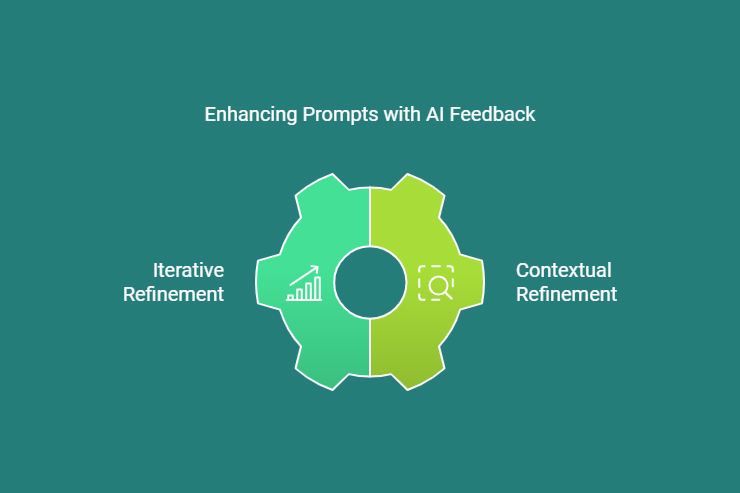
4. Iterative Refinement: Improving Prompts Through AI Feedback
How to Analyze and Refine AI Responses to Improve Results?
One of the most powerful techniques when working with AI is iterative refinement—the process of analyzing an initial response and adjusting your prompt to improve the output. Think of it as a back-and-forth conversation where you gradually narrow in on the most useful information.
For example, you might start with a general request:
- Initial Prompt: “Summarize digital marketing strategies.”
The AI might provide a broad overview of various digital marketing approaches like content marketing, SEO, and paid advertising. If you realize you need more specific information on social media marketing, you can follow up with a more focused request: - Follow-Up Prompt: “Expand on social media marketing techniques.”
Refine your prompt to guide the conversation toward the specific information you need. This approach ensures you’re not stuck with generic outputs.
Pro Tip: Always review the AI’s response carefully before proceeding. If it seems off-topic or incomplete, adjust your prompt and ask for more clarity. The key is not to accept the first answer as final but to iterate until you get the desired level of detail and accuracy.
How to Use Contextual Refinements to Make AI Output More Relevant?
Add contextual refinements based on previous responses to make AI output more tailored. If the AI’s answer is too broad, refine your prompt to focus on specifics.
For example:
- Initial Prompt: “Give an overview of digital marketing trends.”
The response may be broad, covering various aspects of marketing like SEO, content marketing, and B2B strategies. - Contextual Refinement: “Now focus on B2B strategies for small businesses.”
With this refinement, the AI’s focus, providing more relevant and actionable insights. Combining iterative refinement with contextual adjustments boosts relevance and clarity in AI responses.
5. Advanced Prompt Techniques for Complex Requests
How to Handle Complex Tasks Using Step-by-Step Prompts?
When asking AI to handle more complex tasks, it’s often helpful to break the request into clear, manageable steps. This helps the AI provide a more structured, organized response, which is particularly useful when you’re dealing with multifaceted tasks that require a detailed approach.
For example:
- Step-by-Step Prompt: “Provide a 3-step approach to implement an AI-based content strategy.”
- By specifying that you want a step-by-step response, the AI knows to break the task down into distinct phases, like researching the right AI tools, implementing content automation, and refining content strategies with AI-generated insights.
Breaking down the task ensures that the response is not overwhelming or convoluted. Instead, it provides a logical flow of actions that you (or your team) can follow more easily. This structured approach also reduces the chances of missing critical steps in a process.
How to Effectively Manage Multi-Task Requests in AI Prompts?
In some situations, you may need the AI to handle multiple tasks within a single prompt. The key to getting useful results is to structure your request clearly, ensuring that each task is well-defined and the AI knows exactly how to handle them.
For example:
- Multi-Task Prompt: “Compare Python and Java for AI development in terms of speed, versatility, and community support.”
- This prompt asks the AI to handle three distinct tasks: comparing Python and Java based on speed, versatility, and community support. By organizing the prompt in this way, the AI will likely provide a response that covers each area separately, allowing for easy comparison between the two programming languages.
When combining tasks, ensure each element is clear and precise to avoid disjointed responses. This saves time and ensures well-structured, actionable results. Step-by-step breakdowns and multi-task management help handle complex queries efficiently, producing comprehensive, easy-to-follow AI responses.
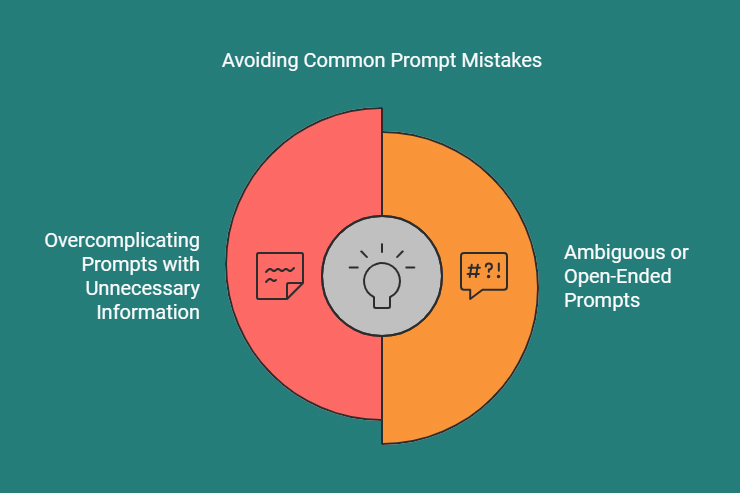
6. Common Mistakes and How to Avoid Them
How to Avoid Ambiguous or Open-Ended Prompts?
One of the most common mistakes when crafting AI prompts is being too vague or ambiguous. Prompts like “What’s new in technology?” are open-ended and can lead to overly broad or irrelevant outputs because the AI has no clear direction on what aspect of technology you’re interested in—software? Hardware? Emerging trends?
Example of a vague prompt:
- “What’s new in technology?”
- This could result in a response covering a wide range of topics like AI, quantum computing, or even social media trends, most of which might not be useful.
How to fix it:
- “What are the top 3 AI advancements in content creation tools in 2024?”
- This refined version asks for specific information about AI advancements in a particular context, ensuring the AI focuses on relevant trends.
By being specific in your requests, you help the AI deliver more accurate, useful results. Always frame your prompt around a clear goal or objective, so the AI knows exactly what to deliver.
How to Avoid Overcomplicating Prompts with Unnecessary Information?
Another common mistake is overloading your prompt with too much information. Including unnecessary details can confuse the AI or dilute the main point of the prompt, leading to less focused responses. The key to getting better results is simplicity.
Example of an overly detailed prompt:
- “Can you, in as much detail as possible, explain the intricacies of how neural networks function within the broader context of deep learning, while also touching on how backpropagation works, and how it compares to other algorithms like gradient descent?”
- This prompt is packed with multiple requests and too much information, which could overwhelm the AI and result in a scattered response.
Simplified prompt:
- “Explain how neural networks work in deep learning.”
- Once you receive this response, you can follow up with more specific questions like “Now explain backpropagation in neural networks” or “Compare backpropagation to gradient descent.”
Simplicity leads to clearer, more concise responses. You can refine the prompt with more details later, instead of overloading the AI upfront. Keeping it simple improves both clarity and relevance.
7. Interactive Exercise: Test Your Prompt Crafting Skills
Below are some AI prompts that need improvement. Your task is to refine each one by making them more specific, clear, and concise. After you’ve revised the prompt, check how your changes affect the AI’s responses!
Instructions:
- Read the provided bad prompt.
- Rewrite it in the field provided to make it more specific and effective.
- Use your new prompt with your AI tool and compare the results.
Prompt 1:
Bad Prompt: “Tell me about AI.”
Prompt 2:
Bad Prompt: “Explain machine learning.”
Prompt 3:
Bad Prompt: “What’s new in technology?”
Prompt 4:
Bad Prompt: “Give me some marketing tips.”
Final Step: Test each improved prompt in your AI tool and observe how refining your prompts leads to clearer, more accurate, and relevant responses.
Pro Tip: Keep refining your prompts based on the AI’s feedback, and practice regularly to become a prompt crafting expert!
After practicing, share your best-refined prompts in the comments below to inspire others!
8. Mastering the Art of Prompt Engineering
Crafting effective AI prompts requires specificity, clarity, and conciseness. The more focused your prompt, the more accurate and relevant the AI’s response will be. Iterating and refining based on feedback is key to improving results.
Take time to practice writing and refining your prompts, testing different approaches, and observing how the AI’s output changes. As you hone this skill, you’ll unlock the full potential of AI tools for your needs.
Start experimenting with prompts now and see how quickly you can improve your results!
Sources and further readings
Semanticscholar Use ChatGPT to maximize everyday efficiency (link)
National Library of Medicine: Generative AI for Visualization (link)
Learn more about AI Prompt Techniques and Engineering
» Chain-of-Thought Prompting
» Few-Shot Prompting
» Zero-Shot Prompting
» AI Prompt Techniques and Strategies
» AI Prompt Optimization Methods
» AI Prompt Templates
Enhance your prompting skills and explore more guides at our AI Prompt Learning Center to stay ahead in AI.
