

AI Prompt Learning Center
Dynamic AI Prompting Explained: Tips, Benefits, and Trends

Did you know that 85% of customer interactions are now handled without a human agent? This shift is largely thanks to advancements in AI, including a game-changing technique called dynamic prompting.
But what exactly is dynamic prompting, and how is it reshaping industries like customer service, healthcare, and education? In this article, we take a closer look at how this technology is making interactions smarter, faster, and more personalized, opening up new possibilities across various sectors.
What You Will Learn:
- How can dynamic AI prompting improve your interactions with AI tools?
- Why are real-time adjustments crucial for getting better, more accurate responses?
- What makes dynamic prompting ideal for applications like customer service and content creation?
- How can you use dynamic prompting to tailor AI outputs to your specific needs?
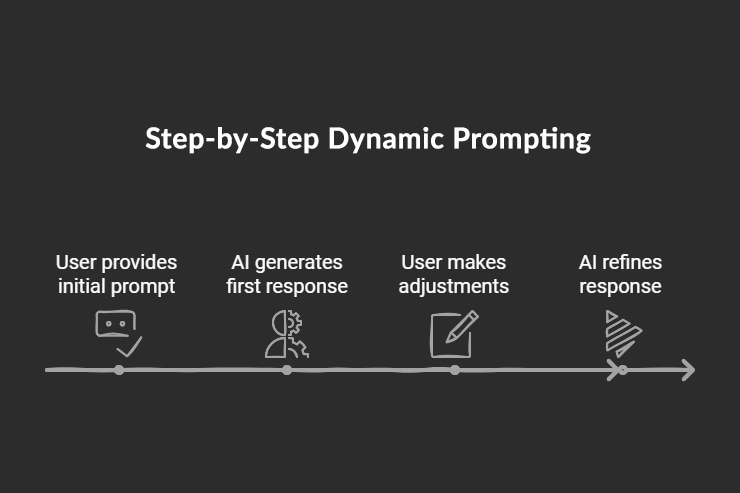 1. Understanding the Reader’s Intent with Dynamic AI Prompting
What Is Dynamic AI Prompting?
Dynamic AI prompting lets you adjust your interactions with AI in real-time for more accurate responses. Unlike static prompting, which gives a single response, dynamic prompting allows you to tweak your prompts based on initial answers, guiding the conversation until you get the desired outcome.
For example, you might ask for travel suggestions, then refine the request with, “Can you focus on places in Europe?” or “What about budget-friendly options?” This process helps the AI better meet your needs.
Comparison with Static Prompting:
- Static Prompting: You ask once, and the AI responds. This is ideal for simple requests but can lack depth if the initial response misses the mark.
- Dynamic Prompting: You interact continuously, guiding the AI’s output until it aligns with your needs. This is better for more complex or evolving queries where the first answer might not be enough.
Importance of Adaptability and Real-Time Adjustments: Dynamic prompting lets you adjust your approach as the conversation evolves, especially when context or details change. This refinement leads to more accurate exchanges, shaping AI responses to better meet your needs and improving efficiency and satisfaction.
Why Does Dynamic Prompting Matter?
Dynamic prompting can significantly enhance the quality of AI-generated responses. By making real-time adjustments, you can ensure that the AI’s output better aligns with your specific goals or questions. This approach helps improve response accuracy, making AI interactions more valuable and relevant.
How Dynamic Prompting Improves Response Accuracy
Adjusting prompts in real time allows you to clarify or add details that the AI might have missed initially.
For example, if you’re using AI to draft an email, you might start with a general prompt like “Write an email to a new client.”
After seeing the draft, you can refine it by saying, “Make the tone more casual” or “Focus on the project’s benefits.”
Each adjustment helps the AI better understand what you’re looking for, resulting in a more precise output.
Scenarios Where Dynamic Prompting Is Crucial:
- Customer Service: Dynamic prompting helps chatbots adapt to customers’ evolving needs during a conversation, ensuring accurate and helpful responses. For instance, when a customer’s issue becomes more complex, real-time prompt adjustments can help the AI refine its suggestions.
- Creative Brainstorming: When using AI for generating ideas, such as writing or content creation, dynamic prompting allows you to guide the AI through different iterations. This ensures that the output matches the creative vision or focus you have in mind.
Adaptive AI Models Key Players: OpenAI and Google DeepMind have led the development of adaptive AI models that learn from input and adjust based on user feedback. OpenAI’s GPT-4 excels at understanding context, while Google DeepMind focuses on creating models that adapt quickly to user needs, making interactions more intuitive and personalized.
2. How Dynamic AI Prompting Works
The Basics of Real-Time Adjustments
Real-time adjustments in dynamic AI prompting let you refine responses by modifying prompts during interactions, guiding the AI toward more precise answers, especially when initial responses are too broad or vague.
Overview: How Real-Time Adjustments Work
When interacting with an AI, you can start with a general prompt and adjust it as you go, based on the AI’s response. This continuous refinement helps in zeroing in on the exact information or tone you’re looking for. It’s like giving feedback during a conversation, where each tweak you make helps the AI better understand your intent.
Step-by-Step Example:
1. Start with a Basic Prompt:
- You type: “Give me some tips for a healthy diet.”
- AI’s Initial Response: The AI might respond with general tips like “eat more vegetables” or “stay hydrated.”
2. Adjust Based on the AI’s Initial Response:
- If you find the response too broad, you can refine your prompt: “Focus on tips for a vegetarian diet that includes high protein.”
- AI’s Adjusted Response: Now, the AI might suggest options like “Include lentils and chickpeas for protein” or “Try tofu and tempeh.”
3. Show How Tweaks Change the Output:
- If you want more detail, you can adjust further: “Can you include specific recipes with these ingredients?”
- AI’s Further Adjusted Response: The AI might now provide recipe ideas like “Chickpea and spinach curry” or “Tofu stir-fry with vegetables.”
Each adjustment brings you closer to the desired outcome, allowing you to shape the interaction dynamically.
Adaptive Models in Action
Adaptive AI models are designed to learn from user inputs and improve their responses over time. Unlike fixed models that rely solely on pre-set rules and data, adaptive models use ongoing interactions to refine their understanding and predictions.
How These Models Work:
- Adaptive models can analyze user feedback and adjust their approach based on the context and content of prompts. They utilize machine learning techniques to become more accurate as they process more interactions, leading to a more personalized experience.
- For example, models like GPT-4 or Google’s Gemini can adapt to a user’s writing style, preferences, or the specific language used during a conversation, making each interaction progressively more aligned with the user’s needs.
Adaptive Models:
- OpenAI’s GPT-4: Known for its ability to handle complex conversations, GPT-4 can adjust its responses based on clarifications and follow-up questions, making it suitable for dynamic prompting scenarios.
- Google: Bard and Gemini, developed by Google DeepMind, is designed for real-time adaptation, with a focus on generating creative and contextually accurate responses. It continuously learns from interactions, making it ideal for dynamic conversations that require adjustments.
Comparison Table Between Static and Dynamic Prompting:
| Features | Static Prompting | Dynamic Prompting |
| Adaptability | Low – Responses are based on a single prompt | High – Responses evolve based on follow-up adjustments |
| Response Quality | Limited to initial output | Improves with user feedback and prompt modifications |
| Use Cases | Simple queries or direct answers | Complex interactions like customer service or brainstorming |
| Learning Curve | Easy for beginners | Moderate – Requires understanding of how to adjust prompts |
3. Best Practices for Dynamic AI Prompting
Techniques to Refine Prompts for Better Responses
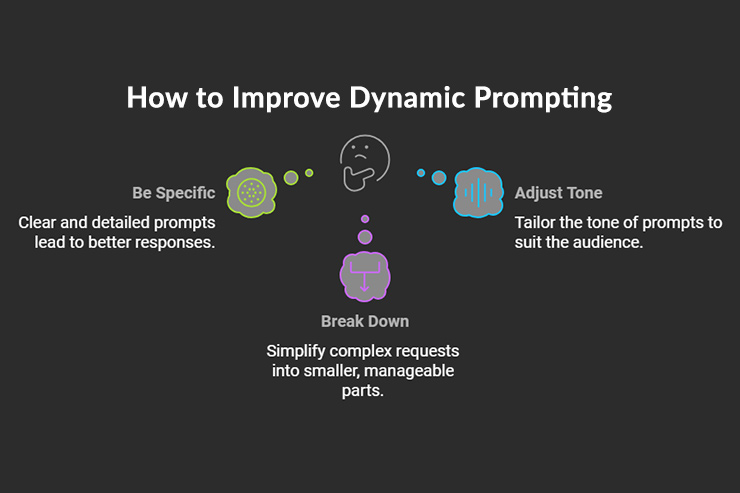
- Be Specific: The more specific your prompt, the more focused the AI’s response will be. For example, instead of asking, “Tell me about marketing,” you might refine it to, “Give me three social media marketing strategies for small businesses.”
- Clarify the Desired Tone: Adjust the tone of responses by specifying it in the prompt. For example, if you want a friendly tone, you can add, “Write in a friendly and approachable manner,” or if you need a formal tone, you could specify, “Draft this as a formal email.”
- Break Down Complex Questions: If a response seems too general or unclear, break down your questions into smaller parts. Instead of “How can I improve my website and increase traffic?” try “How can I improve my website’s user experience?” followed by “What are effective ways to drive more traffic to my website?”
How to Identify When a Prompt Needs Adjustment
- Unclear or Vague Responses: If the AI’s initial response is too broad or misses the mark, it’s a sign that the prompt needs to be more specific.
- Misinterpretation of Intent: If the AI provides an answer that doesn’t align with your request, adjusting the wording or adding context can help clarify your intent.
- Too Much or Too Little Information: When the AI’s response is too lengthy or too brief, specify the desired length or the depth of detail in your follow-up prompt.
Example: Adjusting Tone, Specificity, and Question Structure
- Initial Prompt: “Explain digital marketing.”
- AI’s Response: Provides a broad overview of digital marketing.
- Refined Prompt: “Explain digital marketing strategies for B2B companies in a friendly tone.”
- Result: The AI now tailors its response to focus on B2B strategies, with a more conversational style.
Adapting to User Feedback
Importance of Listening to the User’s Feedback
- When using AI in settings like customer support or content generation, listening to feedback is crucial. Users may express dissatisfaction or request clarifications, providing valuable input that can be used to refine the AI’s responses.
- AI models can adapt to this feedback over time, allowing them to offer better answers in future interactions. This adaptability enhances user satisfaction, as the AI becomes more in tune with individual preferences and needs.
How AI Models Adapt to User Preferences Over Time
- Through techniques like reinforcement learning, AI can learn from feedback loops. For instance, if a user frequently adjusts the tone of responses from “formal” to “casual,” the AI can learn to default to a more casual tone for that user.
- This adaptability is especially useful in scenarios like customer service, where tailored responses are key to creating a positive user experience.
Example of Using Dynamic Prompting in Customer Support
- A customer reaches out with a complex issue: “I’m having trouble with my order and need help understanding the return process.”
- Initial Response: The AI might give a generic answer about returns.
- Adjusted Prompt: “Can you provide step-by-step instructions for returning an item, and address common issues customers face?”
- Result: The AI’s refined response is more detailed and better addresses the customer’s needs, leading to a higher likelihood of customer satisfaction.
Case Study: Dynamic Prompting in E-commerce Chatbots
Brief Case Study on Enhancing User Satisfaction
In e-commerce, companies like Amazon use dynamic prompting to enhance customer interactions, allowing chatbots to adjust responses based on user input for personalized assistance.
- Example: A customer asks, “What’s the best laptop for gaming?” The chatbot starts with general recommendations. If the customer specifies, “I’m looking for something under $1,000,” the bot dynamically adjusts its response, filtering results to match the price range. This iterative interaction helps the user find exactly what they need, and increasing satisfaction.
Data Points and Industry Insights
- According to a report by Forrester Research, dynamic AI interactions in customer service can lead to a 20% increase in user satisfaction due to more personalized and accurate responses.
- Gartner notes that companies using AI chatbots with adaptive capabilities have seen up to a 30% reduction in resolution times, thanks to the ability to adjust responses in real time.
How Companies Like Amazon Use Adaptive AI for Personalized Recommendations
Amazon uses dynamic AI prompting in its recommendation engine to refine suggestions based on customer browsing history and feedback. If a user skips certain recommendations, the AI adjusts to suggest more relevant products, improving the shopping experience and boosting conversion rates. Real-time adjustments in AI can enhance interactions in customer support, content creation, and more.

4. Advantages Dynamic AI Prompting
Enhanced Efficiency in Content Creation
Dynamic AI prompting significantly boosts efficiency in content creation processes. By utilizing generative AI models like GPT-3 and GPT-4, content creators can generate tailored outputs that meet specific audience needs and preferences, ultimately saving time and effort compared to traditional methods. This allows businesses to streamline their content strategy and adapt quickly to market demands. [Source]
Improved Personalization
AI technologies enable a higher degree of personalization in content delivery. By analyzing user data and behavior, AI can curate unique experiences tailored to individual users, thereby increasing engagement and customer loyalty. This personalization fosters stronger connections with audiences, as it anticipates their preferences and concerns. [Source]
Data-Driven Decision Making
Incorporating AI into content strategies allows creators to leverage vast amounts of data for informed decision-making. This data-driven approach ensures that content remains relevant and adapts to shifting user needs and preferences, enhancing overall effectiveness[19]. By continuously analyzing data, businesses can fine-tune their strategies and prompt designs, leading to improved outcomes. [Source]
SEO Optimization
AI-generated content can be effectively aligned with SEO strategies, optimizing it with relevant keywords and enhancing its visibility in search engine results. This alignment not only increases organic search traffic but also ensures that content reaches the intended audience more effectively, which is crucial for maintaining a competitive edge in the digital landscape.
Cost Savings
The deployment of automated self-service platforms, powered by AI, allows organizations to generate bespoke content—such as bank statements and analytical summaries—at scale. This automation reduces the need for extensive manual labor, resulting in substantial cost savings and freeing up human resources for more strategic tasks [Source].
Facilitated Engagement and Retention
AI technologies play a pivotal role in creating engaging content that attracts and retains audience interest. By developing compelling narratives and interactions, organizations can build a loyal community around their brand, fostering long-term relationships with customers. Enhanced engagement is key to sustaining business growth and maintaining a competitive presence in the market.
Support for Innovation and New Job Creation
The integration of AI in various sectors is not only about improving existing processes but also about driving innovation. As AI technologies evolve, they pave the way for new occupations and opportunities, potentially accounting for a significant percentage of jobs created by 2030. This growth can contribute to broader economic dynamism and job creation [Source].

5. Dynamic AI Prompting Applications Across Industries
Artificial intelligence (AI) and machine learning (ML) are changing how many industries work, from customer service to managing inventory. Here some examples from various industries:
Customer Service
AI-powered customer service tools have transformed how businesses connect with their clients. With real-time responses and conversational AI, companies can handle customer questions faster, boosting satisfaction and loyalty. As AI gets smarter, we can expect even more changes in how businesses interact with their customers. [Source]
Financial Services
The financial industry has gained a lot from AI. Banks use AI to sift through huge amounts of data to detect fraud, stopping problems before they grow. Since fraud tactics keep changing, it’s crucial for banks to use AI that can spot new patterns and adapt quickly [Source].
Hospitality
AI helps the hospitality industry offer personalized experiences for travelers, using detailed profiles. After the challenges of the COVID-19 pandemic, hotels and restaurants have embraced automation to speed up service and make guests happier. AI can simplify check-ins and provide real-time updates on travel delays, making the entire experience smoother.
Manufacturing
AI is making a big impact on manufacturing by helping businesses optimize processes, speed up tasks, and increase accuracy on the production line. As more industries go digital, AI is becoming a key tool for improving customer experiences over time. [Source]
Logistics and R&D
In logistics and research and development (R&D), AI helps cut costs and shorten research timelines. Industries like biotech and oil and gas use AI to take on innovative projects with less financial risk. With AI, these sectors can make better decisions and achieve more progress in their fields.
6. Common Challenges and Solutions in Dynamic AI Prompting
Challenges in Real-Time Adjustments
1. Misinterpretation of Prompts
- Sometimes, AI may not fully understand the nuances or specifics of a user’s request, leading to responses that don’t match the intended outcome. This can be especially common in complex or multi-layered queries where clarity is key.
2. Over-Adjusting and Leading to Inconsistent Responses
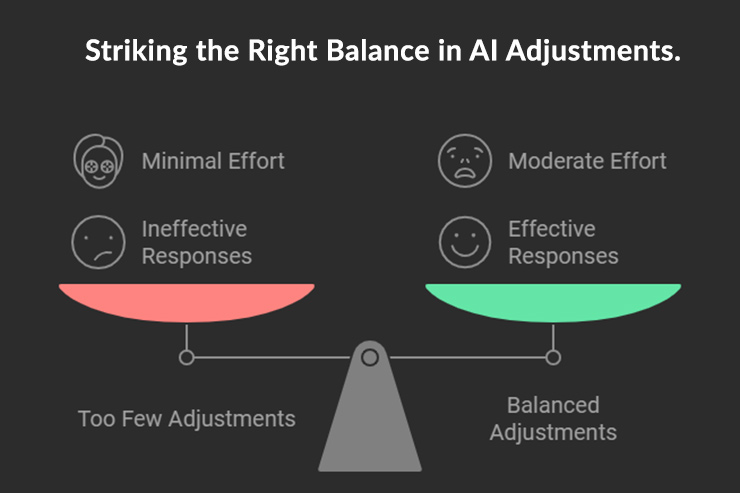
- While real-time adjustments are powerful, there’s a risk of over-adjusting. Too many tweaks or frequent changes can cause the AI to produce inconsistent responses, making it harder to maintain a clear direction in the conversation.
3. Balancing User Needs with AI Capabilities
- Users often expect AI to perform like a human conversational partner, but it’s important to recognize the limitations of the technology. Striking a balance between user expectations and what the AI can realistically deliver is crucial for maintaining a smooth interaction.
Solutions and Strategies
1. Using Feedback Loops Effectively
- Feedback loops can be used to help the AI understand user preferences over time. By providing clear feedback—such as “This isn’t quite what I meant” or “Can you focus more on X?”—users can guide the AI’s learning process and improve future interactions.
2. Avoiding Over-Complication by Keeping Prompts Simple
- Simplicity is key when crafting prompts. Instead of using overly detailed or complex prompts, break down the information into smaller, more manageable requests. This not only makes it easier for the AI to understand but also ensures that responses remain focused.
Example of Finding the Right Balance with Iterative Adjustments:
- Initial Prompt: “Write a marketing plan for a new fitness app targeting young professionals.”
- AI’s Response: Offers a general marketing plan.
- User Adjustment: “Focus more on social media marketing for platforms like Instagram and TikTok.”
- Over-Adjustment Risk: The user then asks for changes repeatedly, leading to a disjointed plan.
- Solution: Instead, the user can gradually adjust—first refining the audience focus, then addressing platforms, and finally specifying content strategies. This iterative approach keeps the adjustments manageable while ensuring the AI stays on track.

7. The Future of Dynamic AI Prompting and Adaptive Models
Emerging Trends in Dynamic AI Prompting
1. How AI Models Are Becoming More Intuitive and User-Friendly
- Advances in AI technology are making models more intuitive, allowing them to better understand user needs without extensive prompting. This means that even users with minimal experience can interact with AI more effectively.
2. The Role of NLP Advancements in Improving Dynamic Interactions
- Natural Language Processing (NLP) continues to evolve, enhancing AI’s ability to understand context, sentiment, and complex instructions. These advancements enable AI to adapt more naturally to user inputs, making dynamic prompting smoother and more effective.
Example: Predictive Text in Apps like Grammarly Using Adaptive AI
- Apps like Grammarly use adaptive AI to suggest real-time corrections and adjustments based on user writing patterns. As you type, the AI learns your style, offering better suggestions with each interaction. This is a practical example of how dynamic prompting can make tools more responsive and tailored to user preferences.
What This Means for AI Users
1. Potential Applications in Various Fields
- Customer service: In customer service, AI can respond more effectively to inquiries, thus resolving issues more rapidly and boosting customer satisfaction levels.
- Marketing: AI can help marketers adapt campaign strategies based on real-time feedback, optimizing ads or content to match audience reactions.
- Healthcare: In healthcare, tailored health advice and improved diagnostic capabilities can be facilitated through responsive AI interactions, leading to better patient outcomes.
- Education: The education sector may also benefit significantly, as personalized learning plans that adapt to individual student needs become more prevalent,
2. Expert Insights on the Future of Adaptive AI
- Sam Altman, CEO of OpenAI, notes, “The future of AI is about creating AIsystems that truly understand context and can adapt to user needs seamlessly.” As models continue to advance, we can expect AI to become a more intuitive partner in everyday tasks.
- Demis Hassabis, CEO of Google DeepMind, has emphasized that “adaptive models will play a key role in making AI more accessible, offering customized solutions that meet the unique needs of users.”
Further readings:
If generative AI accelerates science, peer review needs to catch up
Learn more about AI Prompt Techniques and Engineering
» Chain-of-Thought Prompting
» Few-Shot Prompting
» Zero-Shot Prompting
» Crafting Effective AI Prompts
» AI Prompt Techniques and Strategies
» AI Prompt Optimization Methods
