

Chatbots
Step-by-Step Guide Crafting Compelling Stories with ChatGPT

ChatGPT, an advanced language model developed by OpenAI, has revolutionized the way we interact with artificial intelligence. This powerful tool can generate human-like text based on the prompts it receives, opening up exciting possibilities for creative writing and storytelling. With the help of ChatGPT, writers can improve their storytelling process, overcome writer’s block, and explore new narrative directions they might not have considered on their own.
As I write short stories from time to time, I believed character development, plot intricacies, and emotional resonance were human domains. However, my initial experience with ChatGPT was eye-opening.
While struggling to develop a character, I asked ChatGPT to help me out. I provided a basic description and received several interesting backstory possibilities within seconds. One suggestion became the cornerstone of my story, showing me that ChatGPT could augment and inspire my creativity.
1. Understanding ChatGPT’s Storytelling Capabilities
Before we dive into the practical aspects of using ChatGPT for storytelling, it’s crucial to understand how this AI model works and what it can (and can’t) do for your writing process.
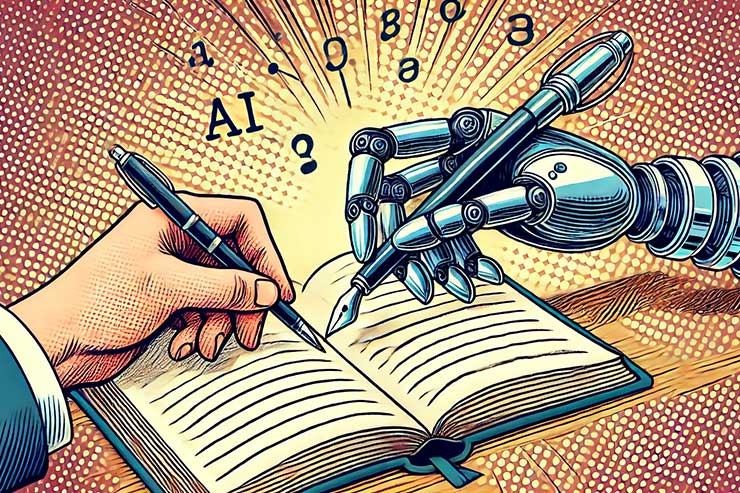
How ChatGPT processes and generates text
ChatGPT is based on a type of AI called a large language model (LLM). It’s trained on vast amounts of text data from the internet, books, and other sources.
When you provide a prompt, ChatGPT doesn’t simply retrieve pre-written responses. Instead, it processes your input and generates new text based on patterns and relationships it has learned from its training data.
This process allows ChatGPT to produce coherent and contextually relevant responses, even to prompts it hasn’t seen before. For storytelling, this means ChatGPT can generate ideas, dialogues, descriptions, and plot elements that are tailored to your specific narrative needs.
Strengths and limitations in storytelling
ChatGPT’s strengths in storytelling include:
- Idea generation: It can quickly produce numerous ideas for plots, characters, or settings.
- Overcoming writer’s block: ChatGPT can provide fresh perspectives when you’re stuck.
- Dialogue creation: It can generate realistic-sounding conversations between characters.
- Descriptive writing: ChatGPT can help with vivid descriptions of scenes or characters.
- Plot development: It can suggest plot twists or help flesh out story outlines.
However, ChatGPT also has limitations:
- Lack of true understanding: While ChatGPT can generate coherent text, it doesn’t truly understand the emotional depth or thematic significance of a story.
- Inconsistency: Without careful prompting, ChatGPT may produce inconsistent details or character behaviors across longer narratives.
- Potential for clichés: ChatGPT might sometimes rely on common tropes or clichés from its training data.
- No long-term memory: ChatGPT doesn’t remember previous conversations beyond the current session, which can make maintaining consistency in longer works challenging.
- Absence of personal experience: Unlike human authors, ChatGPT can’t draw from lived experiences or emotions.
Setting realistic expectations
Given these strengths and limitations, you must to set realistic expectations when using ChatGPT for storytelling. ChatGPT is a powerful tool, but can not replace human creativity, emotional intelligence, or lived experiences.
Think of ChatGPT as a brainstorming partner or a sophisticated idea generator. It can help you explore new directions, overcome creative blocks, and even challenge your assumptions about your story. However, the heart and soul of your narrative – the emotional resonance, the thematic depth, and the unique perspective – must come from you.
Your role is to guide ChatGPT with well-crafted prompts, critically evaluate its output, and skillfully integrate its suggestions into your narrative. You’ll need to refine and edit the AI-generated content, infuse it with your personal style, and ensure it aligns with your overall vision for the story.
Key Takeaway: ChatGPT is a powerful tool for enhancing your storytelling process, but it’s not a replacement for human creativity. Use it to spark ideas, overcome challenges, and explore new possibilities, while relying on your unique voice and vision to craft truly compelling narratives.

2. Preparing for Your Storytelling Session
Before diving into ChatGPT for storytelling, proper preparation is key. This groundwork will help you guide the AI more effectively and maintain control over your narrative.
Defining your story’s core elements
Start by outlining the Prompts for Writing Short Stories:
- Setting: Determine the time and place where your story unfolds. Consider the historical, cultural, and physical environment that will shape your narrative.
- Characters: Create a basic profile for your main characters. Include their names, ages, key personality traits, and roles in the story.
- Plot outline: Sketch a rough arc of your story. Include the main conflict, key events, and the general direction you want the story to take.
Having these elements defined will provide a solid foundation for your interactions with ChatGPT.
Crafting effective prompts for ChatGPT
The quality of ChatGPT’s output largely depends on the quality of your prompts. Here are some tips for crafting effective prompts:
- Be specific: Instead of “Give me a character,” try “Create a profile for a 30-year-old female scientist struggling with a moral dilemma in her research.”
- Provide context: Include relevant details from your story outline to ensure coherent responses.
- Use open-ended questions: Phrases like “What if…” or “How might…” can lead to more creative responses.
- Break down complex requests: If you need extensive information, divide it into smaller, manageable prompts.
Tips for maintaining consistency
Consistency is crucial for a compelling story. Here’s how to maintain it when using ChatGPT:
- Create a story bible: Document key details about your characters, settings, and plot points. Refer to this when crafting prompts.
- Use previous responses: Copy relevant parts of ChatGPT’s earlier responses into new prompts to maintain continuity.
- Regular review: Periodically review the generated content to ensure it aligns with your overall vision.
Key Takeaway: Preparation is crucial for guiding ChatGPT effectively. A well-defined story foundation and carefully crafted prompts will result in more useful and consistent AI-generated content.
3. Step-by-Step Process for Story Creation
Now that you’re prepared, let’s walk through a structured process for creating your story with ChatGPT.
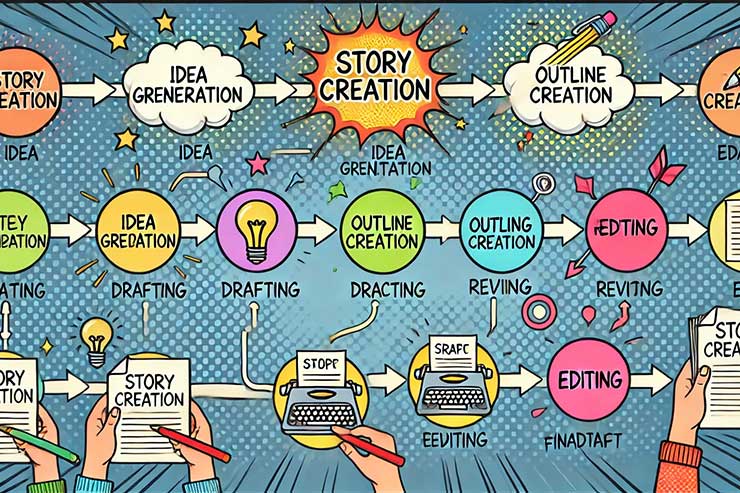
Step 1: Generating story ideas with ChatGPT
Begin by using ChatGPT to brainstorm ideas. You might prompt it with something like: “Generate five unique story ideas involving time travel and ethical dilemmas.”
Review the suggestions and select the most promising one, or use elements from multiple ideas to craft your own unique concept.
Step 2: Developing characters and their backgrounds
Use ChatGPT to flesh out your characters. For each main character, you could prompt: “Create a detailed background for [character name], including childhood experiences, pivotal life events, and how they relate to the story’s central conflict.”
Refine the AI-generated backgrounds to align with your vision, adding personal touches that make the characters uniquely yours.
Step 3: Creating a detailed plot outline
With your characters developed, use ChatGPT to help structure your plot. You might prompt: “Develop a detailed plot outline for a story about [brief story description]. Include the inciting incident, rising action, climax, falling action, and resolution.”
Review and adjust the outline, ensuring it aligns with your original vision and the characters you’ve developed.
Step 4: Writing scene-by-scene with ChatGPT
Now, tackle your story scene by scene. For each scene, provide ChatGPT with context and a specific prompt, such as: “Write a scene where [character] confronts [another character] about [conflict]. The scene takes place [setting details]. Include descriptive elements and dialogue.”
Step 5: Refining and editing the generated content
After generating content with ChatGPT, it’s crucial to refine and edit. Read through the AI-generated text critically. Look for areas to improve, add your personal style, and ensure consistency with your overall narrative.
Key Takeaway: A structured approach yields the best results when working with ChatGPT. By breaking down the storytelling process into defined steps, you can effectively leverage AI assistance while maintaining control over your narrative.
4. Advanced Techniques for Enhancing Your Story
Once you’re comfortable with the basic process, you can use these advanced techniques to further enhance your storytelling.
Using ChatGPT for dialogue generation
ChatGPT excels at creating dialogue. To get the most out of this:
- Provide character profiles before requesting dialogue.
- Specify the emotional state and goals of the characters in the scene.
- Ask for multiple versions of the same conversation to choose from.
For example: “Generate three versions of a dialogue between [character 1] and [character 2]. Character 1 is trying to hide a secret, while Character 2 is suspicious. Their relationship is [describe relationship].”
Creating vivid descriptions and settings
Enhance your story’s atmosphere by using ChatGPT to generate rich, sensory descriptions.
Prompt it with something like: “Describe the sights, sounds, smells, and textures of [location] during [time of day/weather condition]. The mood of the scene should be [desired mood].”
Incorporating plot twists and surprises
ChatGPT can help you brainstorm unexpected turns in your story.
Try prompting: “Suggest three surprising plot twists that could occur at the midpoint of my story, given these established plot points: [list key events].”
Review the suggestions and adapt the most fitting one to your narrative.
Maintaining consistent character voices
To ensure each character has a distinct and consistent voice:
- Create a voice profile for each main character, detailing their speech patterns, vocabulary, and typical expressions.
- When asking ChatGPT to generate dialogue or monologue for a specific character, include this voice profile in your prompt.
- Review and adjust the generated text to further refine the character’s voice.
Key Takeaway: Leverage ChatGPT’s strengths while adding your unique touch. These advanced techniques can help you create more vibrant, surprising, and consistent narratives, but always filter the AI’s suggestions through your creative vision.

5. Troubleshooting Common Issues
As you work with ChatGPT, you may encounter some challenges. Here’s how to address common issues:
Dealing with repetitive or irrelevant content
ChatGPT can sometimes produce repetitive or off-topic content. To mitigate this:
- Refine your prompts: Be more specific about what you want. Instead of “Continue the story,” try “Advance the plot by introducing a new conflict related to [specific theme or character].”
- Use the “temperature” setting: If available, adjust the temperature setting. Lower values (e.g., 0.2) produce more focused, predictable responses, while higher values (e.g., 0.8) increase creativity but may also increase irrelevance.
- Break it down: Instead of asking for a long passage, request smaller chunks of content. This gives you more control and allows for course correction.
- Edit ruthlessly: Don’t hesitate to discard or heavily edit AI-generated content that doesn’t serve your story.
Maintaining plot coherence across long stories
Keeping a consistent plot in a lengthy narrative can be challenging. Try these strategies:
- Create a detailed outline: Develop a comprehensive plot outline before starting, and refer to it regularly.
- Use a “previously on” technique: Before each new writing session, provide ChatGPT with a brief summary of previous events.
- Maintain a story bible: Keep a document with key plot points, character details, and world-building elements. Reference this in your prompts to ensure consistency.
- Regular review: Periodically read through your entire story to catch any inconsistencies or plot holes.
Check out this detailed guide on how to Prompt for Persuasive Essay and learn how to go about this.
Adapting ChatGPT’s tone to match your style
If ChatGPT’s writing style doesn’t match yours:
- Provide style examples: Give ChatGPT a sample of your writing and ask it to emulate that style.
- Be specific about tone: In your prompts, explicitly state the desired tone (e.g., “write in a sardonic, world-weary tone”).
- Post-processing: Consider using ChatGPT’s output as a first draft, then rewrite it in your voice.
- Fine-tune gradually: Start with basic content generation, then incrementally refine prompts to better match your style.
Key Takeaway: Anticipate and overcome challenges for a smoother writing process. With practice and the right techniques, you can navigate common issues and produce more coherent, style-consistent stories.
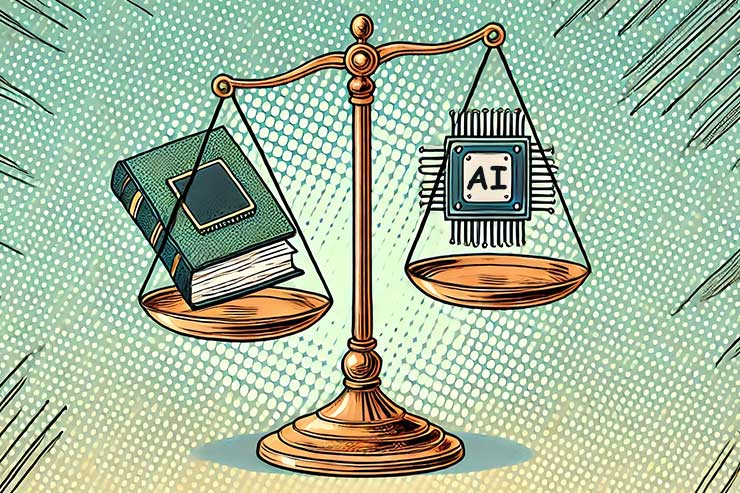
6. Ethical Considerations and Best Practices
Using AI in creative writing raises important ethical questions. Here’s how to navigate them responsibly:
Respecting copyright and originality
While ChatGPT generates original text, it’s trained on existing works. To ensure your work remains original:
- Use ChatGPT for inspiration, not verbatim content: Treat AI-generated text as a starting point, not a final product.
- Avoid prompting for specific, copyrighted content: Don’t ask ChatGPT to mimic specific authors or works too closely.
- Cross-check suspicious passages: If a generated passage seems familiar, check it against existing works to avoid unintentional plagiarism.
- Transform and combine ideas: Mix AI-generated concepts with your own original ideas to create something truly unique.
Disclosing AI assistance in your work
Transparency about AI use is crucial:
- Be open about your process: If you publish or submit your work, consider mentioning that AI was used as a writing aid.
- Clarify the extent of AI use: Distinguish between minor assistance (e.g., brainstorming) and more substantial contributions.
- Follow industry guidelines: Stay informed about and adhere to any AI disclosure requirements in your field or target publications.
- Maintain integrity: Never claim AI-generated work as solely your own creation.
Balancing AI input with human creativity
Preserve the human element in your storytelling:
- Use AI as a tool, not a replacement: Let ChatGPT augment your creativity, not substitute it.
- Inject personal experiences: Incorporate your unique perspectives and experiences, which AI can’t replicate.
- Trust your intuition: If something doesn’t feel right, even if AI suggested it, trust your creative instincts.
- Regularly write without AI: Maintain and develop your personal writing skills independent of AI assistance.
Key Takeaway: Use ChatGPT responsibly and ethically. By respecting copyright, being transparent about AI use, and maintaining a balance between AI assistance and human creativity, you can harness the power of AI while preserving the integrity and uniqueness of your work.
7. Download Free Checklist
This checklist provides a comprehensive overview of the story crafting process using ChatGPT, from initial preparation to final touches. Here’s why this checklist is effective: Download Link
- Comprehensive coverage: It includes all major steps discussed in the article, ensuring no crucial aspect is overlooked.
- Logical flow: The checklist follows a natural progression of the storytelling process, from preparation to final editing.
- Actionable items: Each point is concrete and actionable, giving clear guidance on what needs to be done.
- Flexibility: While comprehensive, the checklist is flexible enough to adapt to different writing styles and story types.
- Ethical reminder: It includes ethical considerations, promoting responsible use of AI in creative writing.
- Final emphasis on human creativity: The checklist concludes with a reminder that ChatGPT is a tool to enhance, not replace, human creativity.
Sources, References:
- OpenAI. (2023). ChatGPT
- Alammar, J. (2023). The Illustrated GPT-2
- National Novel Writing Month. (2023)
Further Reading
- “The Creative Writer’s Guide to AI Tools” by Jane Smith – A comprehensive guide on integrating AI tools into creative writing processes.
- “Ethics in AI-Assisted Writing” by Dr. John Doe – An in-depth exploration of ethical considerations when using AI in creative fields.
- “Prompt Engineering for Writers” by Emily Johnson – A detailed guide on crafting effective prompts for language models in creative contexts.
- “The Future of Storytelling: AI and Beyond” by Prof. Sarah Brown – An academic perspective on how AI is shaping the future of narrative creation.
- “Character Development in the Age of AI” by Michael Lee – Techniques for creating deep, compelling characters with the assistance of AI tools.
- “World-Building with AI: A Science Fiction and Fantasy Guide” by Alex Chen – Specialized advice for using AI in speculative fiction writing.
- “AI and the Evolution of Literary Styles” by Dr. Lisa Wang – An analysis of how AI tools are influencing and potentially changing literary styles.
- “Collaborative Writing: Humans and AI” by Team WriteRight – Insights into effective collaboration between human writers and AI assistants.
Related Product Items
Prompt for Narrative Writing, Prompt for Persuasive Essay, Prompt for Creative Writing, Chatgpt for Academic Writing, Prompt for Story Writing, Prompts for Fiction Writing, Prompts for Writing a Book, Prompts for Writing Short Stories, Chatgpt prompts for Novel Writing, Chatgpt prompts for CV Writing, Chatgpt for Screenwriting, Chatgpt for Assignment, Chatgpt for Email Writing, ChatGPT for Research
